Series Over Single Works: A Painter's Case for Process
Romanian painter Adrian Dică on why series-based practice — from his graduation series to PREAPOCALIPTIC and Seeds — builds clarity, consistency and depth in painting research.
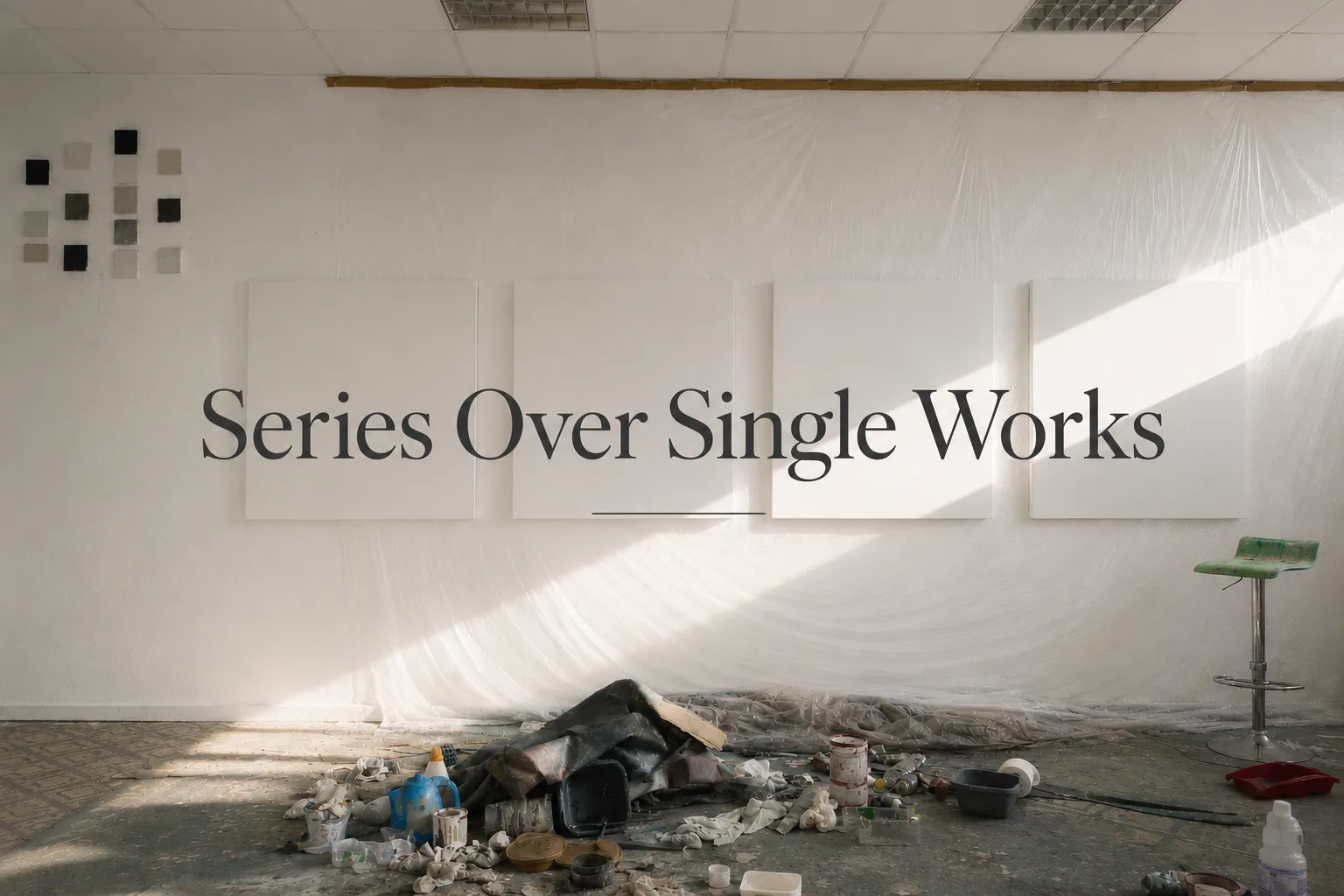
I work in series for a reason rooted entirely in content: any isolated painting claims a closure that fifteen years of experience in front of the canvas consistently contradict. Every series in this path — from the graduation-year works to the instinctive research of today — has grown organically out of the exhaustion of the one before it. The series is a natural consequence of the research itself. It is the only place where an artist's continuity actually becomes visible.
The Great White
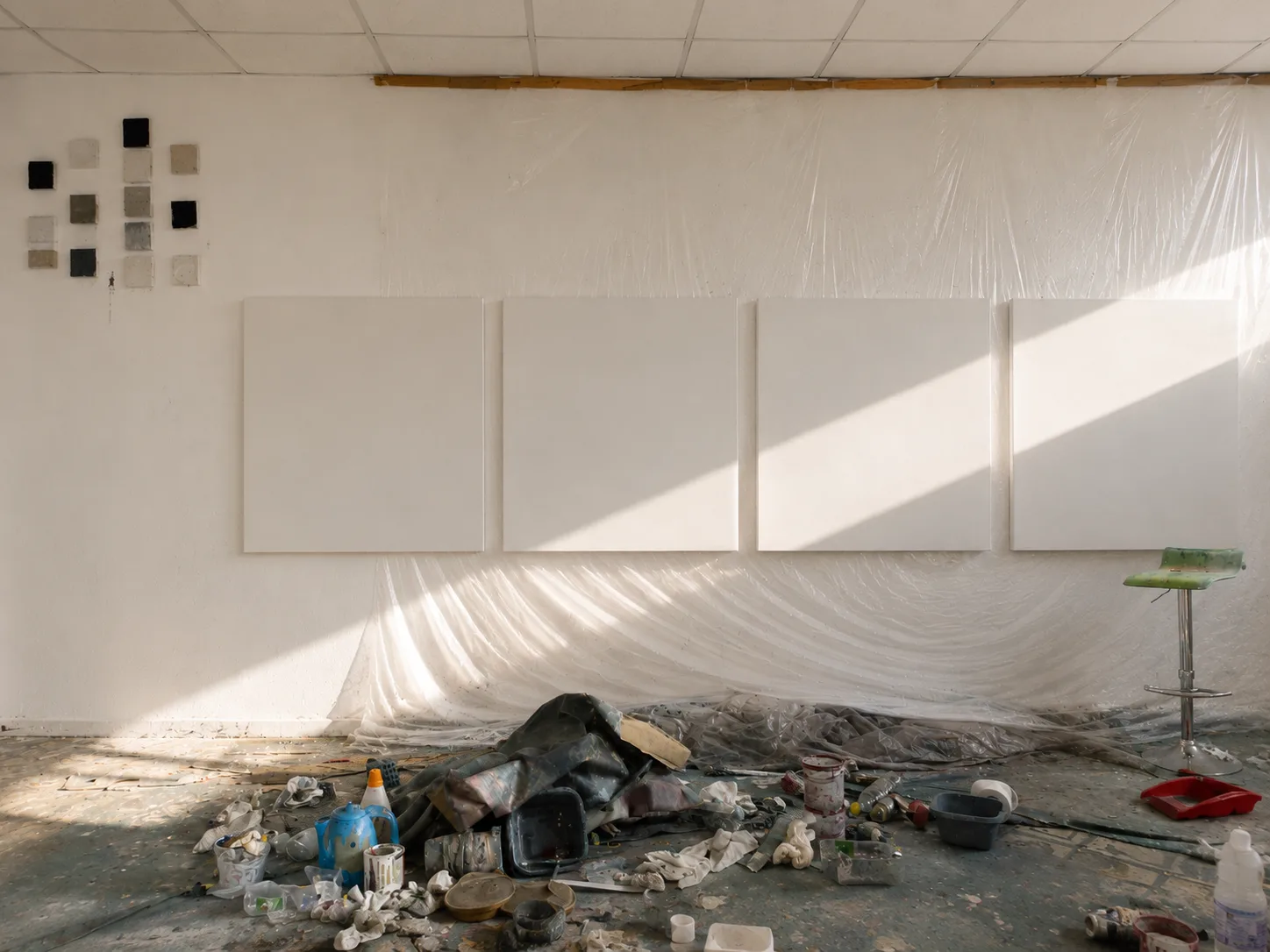
There is a character present in everything I have ever painted, though it never enters the composition itself. I call it the Great White — the blank canvas, before the first stroke, with all the weight the shark comparison carries: vast, unpredictable, calm one moment and turbulent the next, devouring anyone who meets it unprepared. The field of art is an ocean, and the Great White is its unseen predator. Every artist faces it every morning in the studio, regardless of how many finished works stand behind them. I, at least, have negotiated with it differently each time, series after series, for fifteen years.
A Mentor in the Truest Sense
I had the good fortune of a mentor in the truest sense — Marcel Bunea, who guided me alongside other generations of students the best way he knew how: upright, principled, with complete pedagogical rigor. He watched me fumble for years, searching for something still unclear even to me, and chose to wait. When he finally saw the outline of something coherent taking shape, he told me, directly and briefly: make a series of five works like that one.
The first piece from that series was acquired before it ever reached the graduation exhibition wall — purchased by BRD Société Générale Bucharest the moment it was shown. He then let me work steadily for half a year, with only minimal academic corrections. He had asked for five works. I made twelve. The last piece from that series was later sold in the United States, ending up in the office of a collector on Broadway Avenue, New York.
Marcel Bunea has since passed away. From him I internalized, though full understanding came only later, the central benefit of working in series: stillness, focus, consistency.
How One Series Gives Birth to Another
Out of the curiosity generated by that first series came a second: empty, abandoned rooms — a metaphor equivalent to the trash bins that had occupied me until then, a pretext for consolidating form, color, composition, and drawing as applied to painting. These works were exhibited and earned awards and nominations.
From the interior debate of those rooms came a need for unlimited space. I began painting increasingly abstracted landscapes, keeping the same underlying obsessions: waste, solitude, memory, the trace left by human presence in space — now landscape.
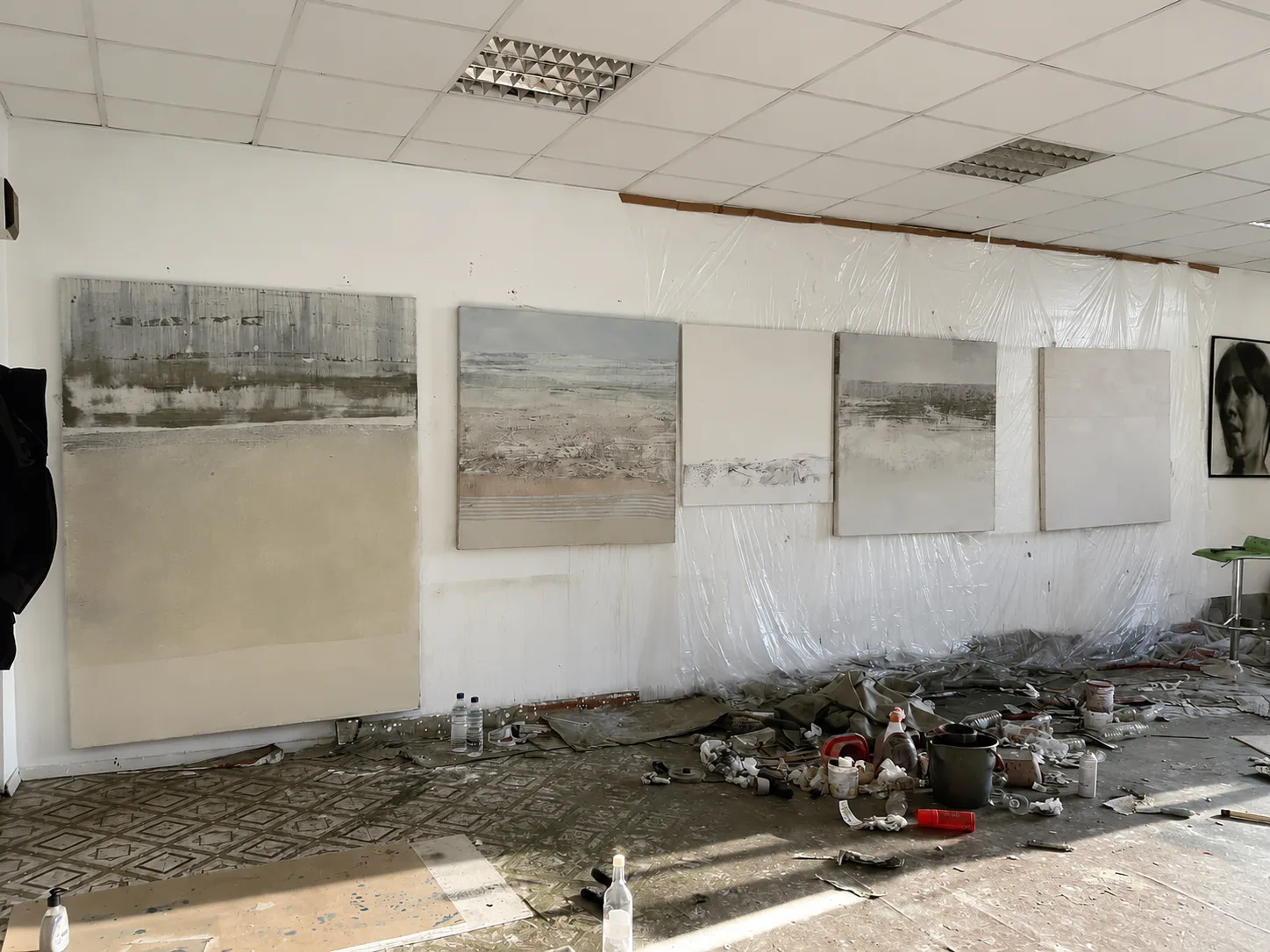
At the same time, I moved from compositions on the harmonic rectangle — an academic compositional inquiry specific to the trash-bin series — to compositions on the square, a necessity for stabilizing the image while pursuing dynamism and inner tension at once. The square is recognized as the most stable and, at the same time, the most difficult form. As a support, it offered a frame limited as architecture, yet infinite as philosophy for the research.
PREAPOCALIPTIC and Beyond the Academy
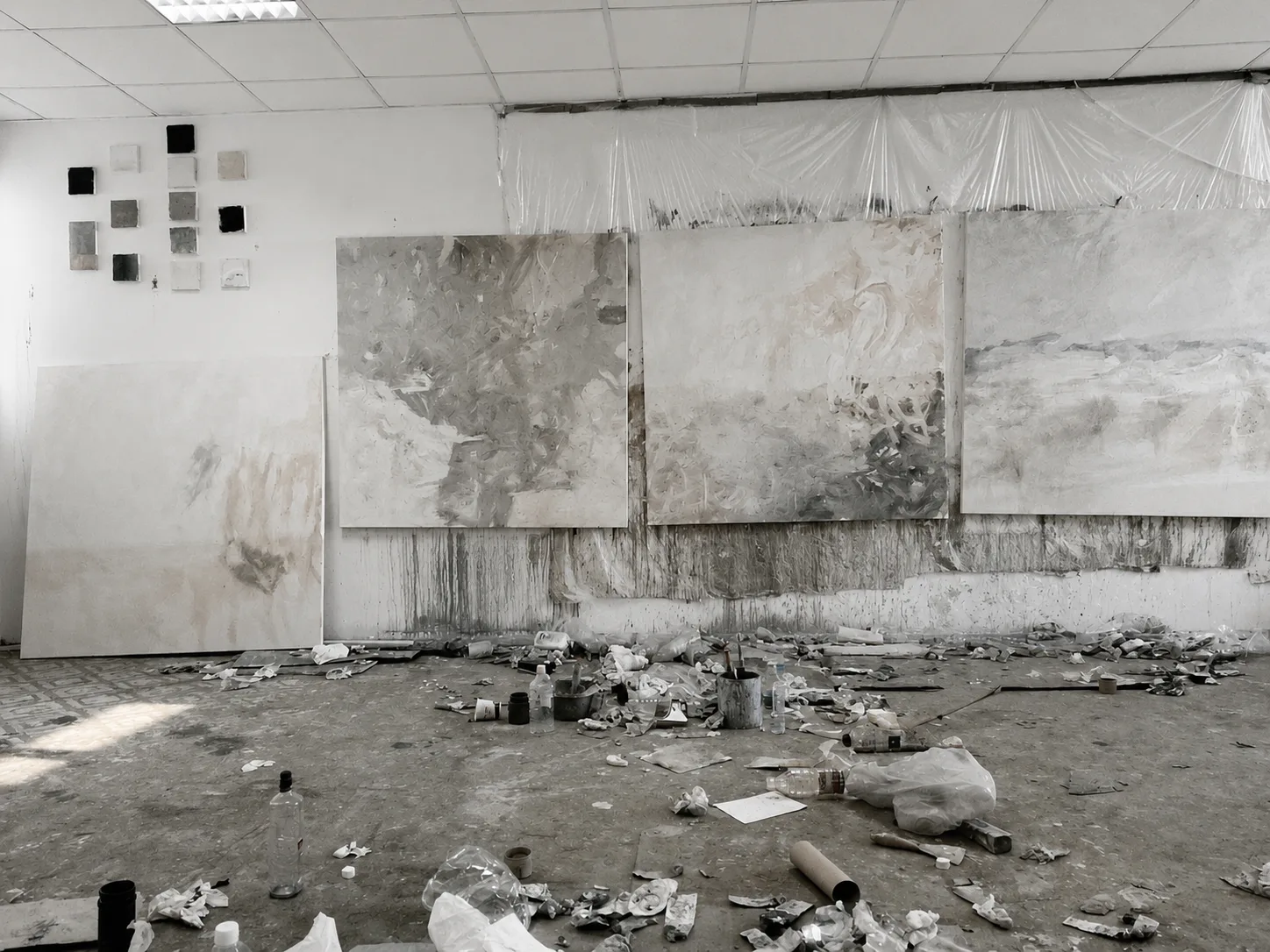
From that tension specific to art, still found within academic reference points — brushwork, color, composition, drawing — came the landscape series PREAPOCALIPTIC.
From there, seeking to minimize the academic role and maximize lived experience — through an intellectual yet controlled inquiry — I moved to a new series: the postindustrial landscapes, visibly more tempered, more restrained in language, yet essentialized. The elements from the beginning of the path remained constant: memory, the trace left by human presence in space.
In parallel, I questioned the quality of the image resulting from working at monumental scale. Keeping the large scale in place, I chose to work also at a scale ten times smaller — 15×15 cm — researching pure pictorial language. From this small format, other similar series later developed, based exclusively on the research of plastic language — part of what is known today as Seeds.
The Return to the Great White
After exhausting, almost instinctively, the postindustrial landscape series — a name that, in the end, served only as a pretext — a new research emerged out of pure curiosity, grounded in the lived experience of the moment in front of the blank canvas. The Great White, the shark, is present now just as constantly as it was on the day Marcel Bunea first saw me fumbling.
This time, the research addresses painting and language beyond intellect and reason — grounded in sense, in instinct, in becoming one with the canvas through gesture and brushstroke. A transposition of lived experience into art through identification. I now work, in parallel, on this instinctive series and on the small-format series.
Why I Recommend Working in Series to Any Artist
Beyond personal experience, working in series is, I believe, a solid practice for any artist starting out or standing at a research crossroads. From fifteen years of studio experience, four concrete benefits emerge consistently:
Clarity. A series removes the pressure of a single work carrying the full weight of an idea. Each piece in a series carries only part of the thought, leaving room for precision — you can test a single variable (color, gesture, composition) while preserving the coherence of the whole.
Consistency of practice. Returning daily to the same conceptual territory builds a sustainable working rhythm, independent of momentary inspiration. The discipline of the series — much like Marcel Bunea's advice: make five — turns the studio from a place of waiting into one of steady production.
Consistency of language. A series develops a recognizable visual vocabulary that deepens with every new work. Over time, this consistency becomes the artist's signature — visible to a collector, curator, or critic tracking an evolution over time, rather than a single isolated snapshot.
In-depth research. A series functions as a controlled experiment: most parameters stay constant while a single one varies, with the result observed work after work. This is how, in this path, the shift from the harmonic rectangle to the square happened, or the move from monumental scale to the 15×15 cm format — each change tested systematically, through a cumulative process, within an entire series.
These four benefits explain, I believe, why most artists engaged in sustained research over time — regardless of medium or generation — eventually come to work in series.
What Connects the First Work to the Last
Placed side by side, the first work from the graduation series and the most recent instinctive piece would, at first glance, appear signed by two different artists. The visual language has changed almost irreconcilably — from academic rigor on the harmonic rectangle to gesture freed from intellect. And yet, something remains identical.
The adversary is the same: the Great White remains constantly present, negotiated differently each time. The core themes have survived every shift in language: memory, the trace left by human presence, solitude — appearing in the trash bins, in the empty rooms, in the landscape, in the postindustrial works, constant at their core. And the method remains the same, even as the outcome transforms radically: each series was born from the exhaustion of the one before it, within a single chain of research that keeps reformulating itself.
The series, seen as a whole, with all its shifts in language, makes an artist's real continuity visible — where a single work shows only an isolated snapshot.
About the Artist
Adrian Dică is a Romanian contemporary painter, with work held in the BRD Société Générale collection and exhibited at the Royal Academy of Arts in London and MoCA Zagreb. His practice centers on the PREAPOCALIPTIC series. Read more about his work and path.