What Trust in an AI Answer and the Authority of an Artwork Have in Common
In a culture where texts can be generated instantly, authority is shifting from content toward source, context, and network. Adrian Dică traces this movement across artificial intelligence, artistic provenance, and the role of art.
Criticism no longer holds a monopoly on legitimation. We live in a culture in which any text can be generated or imitated instantly. My claim is that, in this context, who speaks, from what position, and through which network matters increasingly. I offer this idea as a key for reading the present moment, not as an established truth.
Anyone who works with intelligent systems already knows this pattern: an answer gains trust through its source, not only through how convincing it sounds. The same shift is now taking place in the art world.
Three Examples from Technology, as a Mirror
An AI system gains trust when it grounds its answer in a verifiable source — just as a journalist cites a document rather than merely repeating something heard second-hand. The practice is known as grounding.
A knowledge graph connects the same person to all the places where their name appears, functioning like a digital identity card. Its role is comparable to that of a certificate of authenticity attached to a painting: it helps confirm that the work and the author are exactly who they claim to be.
The C2PA standard attaches a verifiable history to a photograph or video — who created it and through which steps. The art world has used the same underlying principle for centuries under a different name: the provenance of an artwork.
I present these three examples as analogies, not as technical equivalences. The mechanisms solve different problems, but they all reveal the same underlying movement.
A Map of the Shift
| From | Toward | Example |
|---|---|---|
| Criticism | Metacriticism | Who writes the review matters as much as the review itself |
| Data | Metadata | How an image is labelled matters as much as the image |
| Object | Provenance | The path of a painting matters as much as the painting |
| Author | Verifiable identity | A confirmed signature matters as much as the name |
| Text | Citation network | Who cites you matters as much as what you wrote |
Each row describes the same shift at a different scale.
A Work from 2014, Read Today through the Same Lens
I offer the following as an artistic interpretation, open to other readings, rather than as a logical consequence of the argument above.
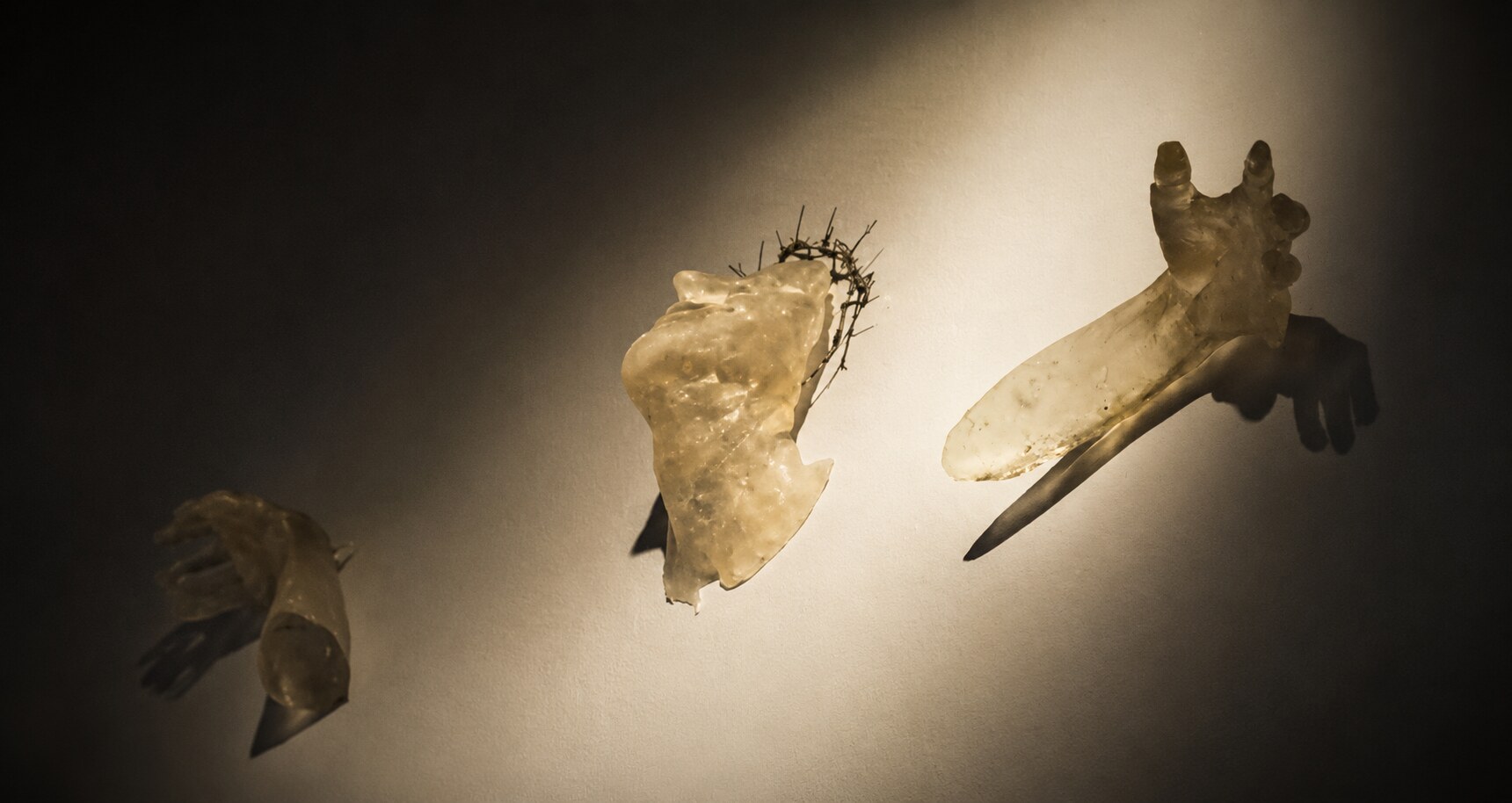
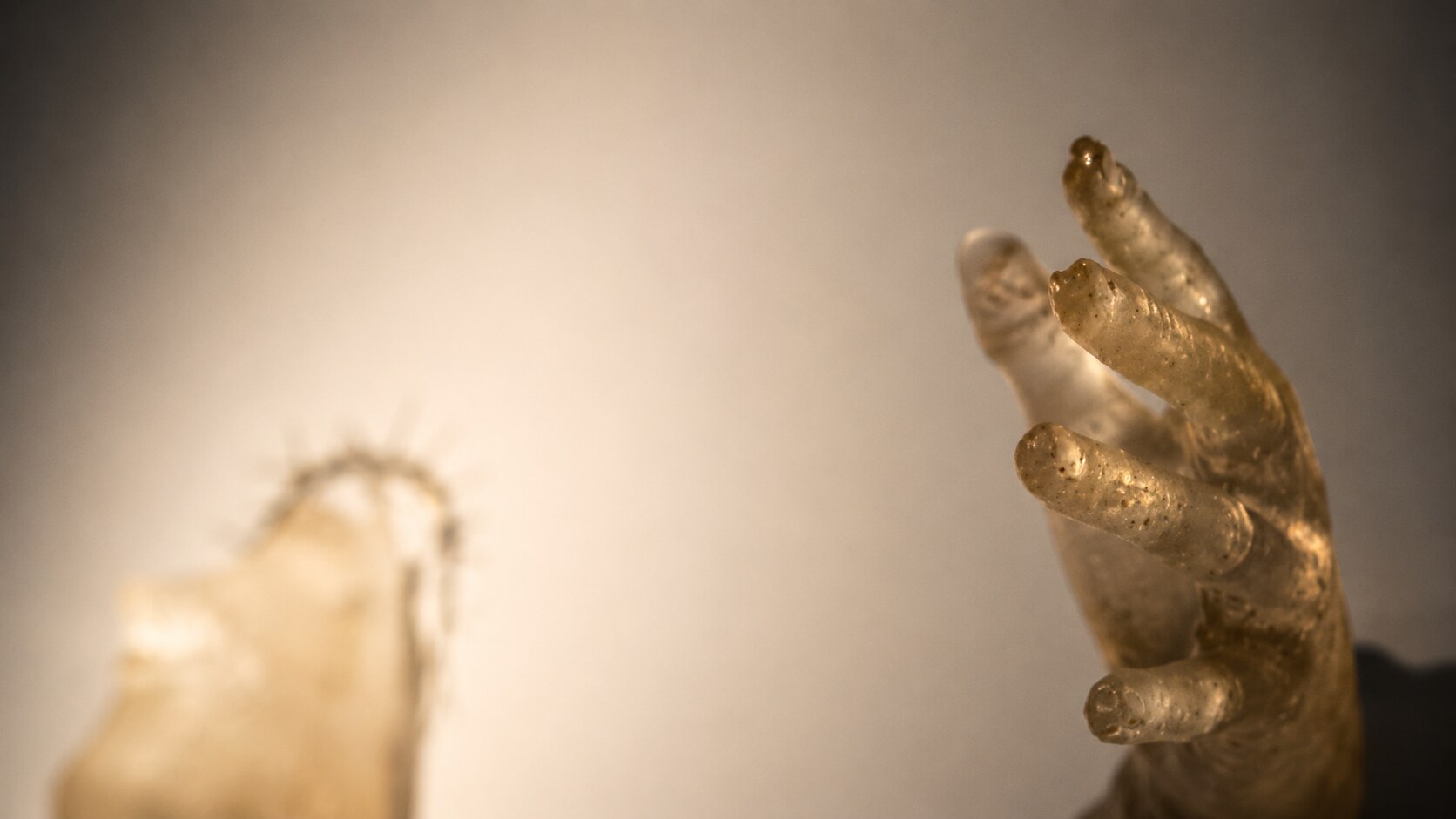
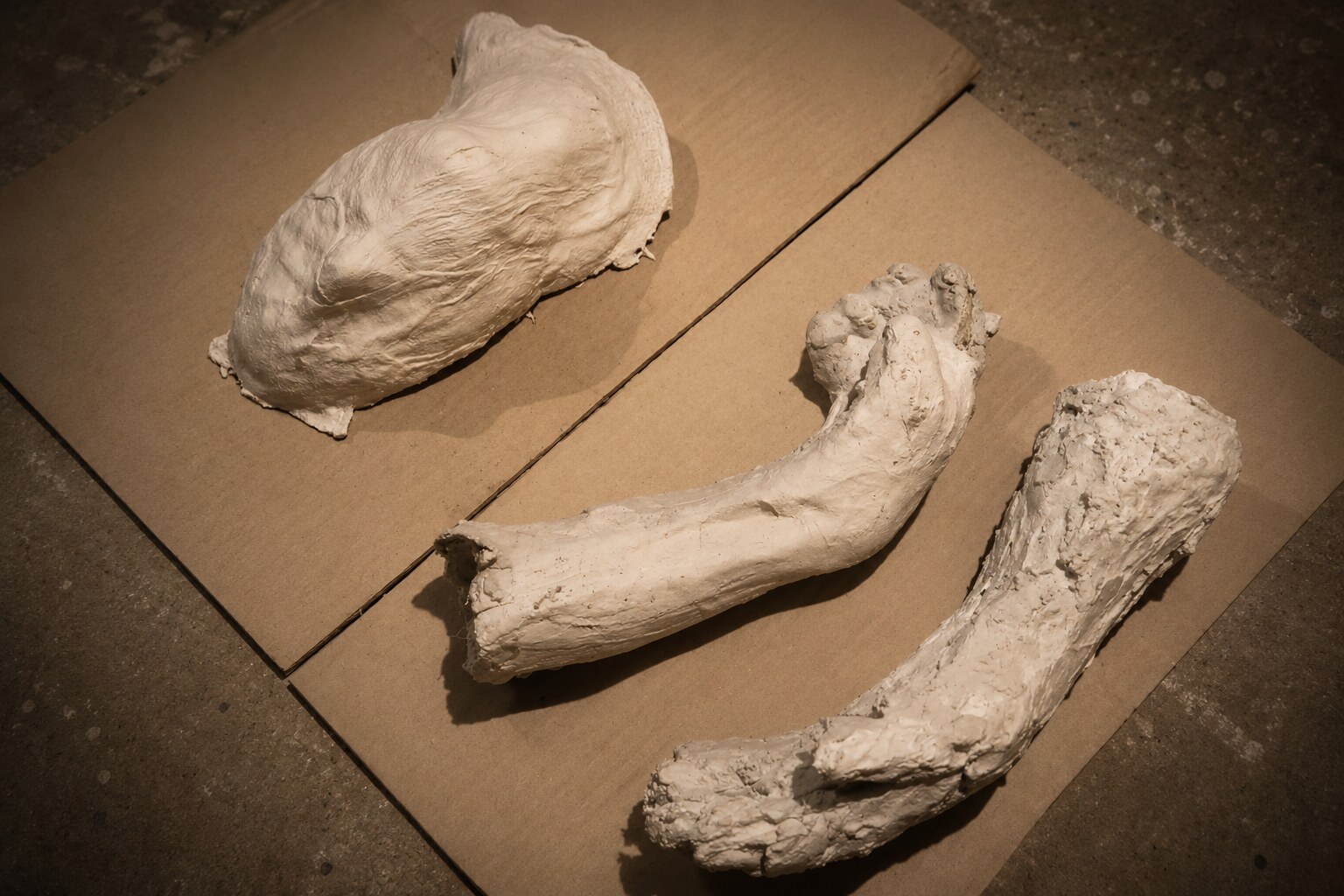
A work exhibited at AnnArt Gallery in the group exhibition *Metha-Lan* presents the head of Jesus with a wire crown of thorns and two hands, all cast in translucent resin. Light falls obliquely across the wall, and the forms emerge from darkness like recovered fragments rather than manufactured objects. The audience at the time met the work with silence — a silence I now read as a sign that its meaning required more time than a single glance could provide.
The translucent resin allows light to pass through the form rather than stopping it — a head and a pair of hands that appear more like traces than statues. The tension of the work lies precisely here: a sacred face cast in an industrial material, suspended ambiguously between relic and laboratory artefact.
A Position Outside the World
Reading the work again today, I find in it an early warning: the temptation to place artificial intelligence in the position of a creator, as a new god.
Art retains, in my interpretation, a different position. Wittgenstein connects ethics and aesthetics to the limits of the representable world, locating them on a transcendental plane beyond what can be stated directly — an idea from Tractatus Logico-Philosophicus (1921), which I read cautiously as support for the role of art as a witness positioned at the edge of the world it observes.
Artificial intelligence brings real benefits and proves useful on an almost all-encompassing scale — while remaining, through all of this, a force within the world, not beyond it. Art finds its purpose precisely in this difference of position.
Note: my own trajectory — the selection for the Royal Academy of Arts Summer Exhibition, the award at the [Chișinău International Painting Biennial](https://www.bipchisinau.com/2021/Adrian-Dica.php), and the presence of works in institutional collections — functions in itself as a publicly verifiable trace, reinforcing the observation above. The conceptual gesture "Art, Money, Life, Invoice" begins from the same observation about legitimacy and systems.
References
Susan Sontag, Against Interpretation (1966); Pierre Bourdieu, Les Règles de l'art (1992); Ludwig Wittgenstein, Tractatus Logico-Philosophicus (1921).