Tick the Box That Says You're Not a Robot
Trust is shifting from the text to the authority that guarantees it — in art as in AI. Adrian Dică argues that the authority of an artwork rests on lived testimony about the creative act, and names the institutional risk "authority laundering".
Not so long ago, measured against the centuries, Flaubert obsessed over le mot juste, rewriting sentences and pages until form and substance became inseparable. Was he, in searching for the right expression, reaching for what philosophy calls logos — the unity of meaning, truth, and utterance? Today, AI models can generate text in an instant. The question has become whether they can produce logos.
I should say, from the outset, that what follows are the thoughts of a visual artist, not a theory — written from inside the practice, biases included.
Authority laundering — a definition
Authority laundering (n.) — the process by which metadata or process documentation enters a system as evidence and exits as a guarantee of authenticity, without anyone having ever answered for the work as lived experience. The term is proposed by the painter Adrian Dică in this essay.
From the work to the context that legitimizes it
A work of art rarely arrives before its audience alone anymore. It is accompanied, always, by a context that shapes how we perceive it: the author's authority and story, the process behind the work, the channels through which it circulates, the communities that validate it. Here, criticism gradually loses its monopoly on legitimation. What a work says matters less; who speaks, from what position, through what medium, and before which audience matters more.
Something similar is already visible in how people relate to artificial intelligence. Frequent AI users have come to believe that the value of an answer depends first on the source it's attributed to. Trust shifts from the text to the authority that produces or guarantees it. This shift in the criterion of validation seems to bring art and technology closer than we might be tempted to admit.
Testimony, the ground of authority
I believe the authority of a work of art rests on the possibility of authentic testimony about the creative act. Testimony gives that authority a face, and when it exists, confirms it. An artist can testify in relation to their own creative act; an AI system can describe its generative process, but cannot claim it as lived experience. This is precisely where the creative act parts ways with mere generation.
It's true — testimony, too, can be simulated. An artist can lie about their process as convincingly as a system can generate a false trail of provenance. The difference lies in the fact that someone puts their name to what they say and risks something by it — reputation, credibility, the trust of those who believe them. Real testimony depends on assumed risk, on coming from someone who lived what they describe. And yet testimony does not exclude the lie — that remains its limit, not its guarantee.
Flaubert needed no one to attest that he had found le mot juste. Testimony and the work were one and the same. The work has always needed criticism, and criticism a metacriticism — a discourse about discourse. Something similar is happening now in technological infrastructure: data required metadata to become findable and verifiable; today, AI systems and knowledge graphs make a similar gesture toward the work and its author — reading the fabric around it, forgetting the content or placing it on a lower tier. From this comes the need to ground any claim in a verifiable source, and for protocols that attach a trace of provenance to a work (such as C2PA). Technology is following a path art has already walked — most visibly since Duchamp — only it shifts the floor on which the stakes are played.
Wittgenstein showed that certain certainties function as hinges for our entire system of belief, unverified — a backdrop we assume without testing it. I read testimony the same way: it is the ground on which our shared trust rests.
The risk: authority laundering
If any documented process passes for testimony, responsibility becomes simulable. A work can enter circulation without anyone ever having answered for it as lived experience, and can leave circulation legitimized solely by its appearance. An institution that fails to make this distinction risks becoming an instrument of authority laundering — a place where metadata goes in as evidence and comes out as guarantee.
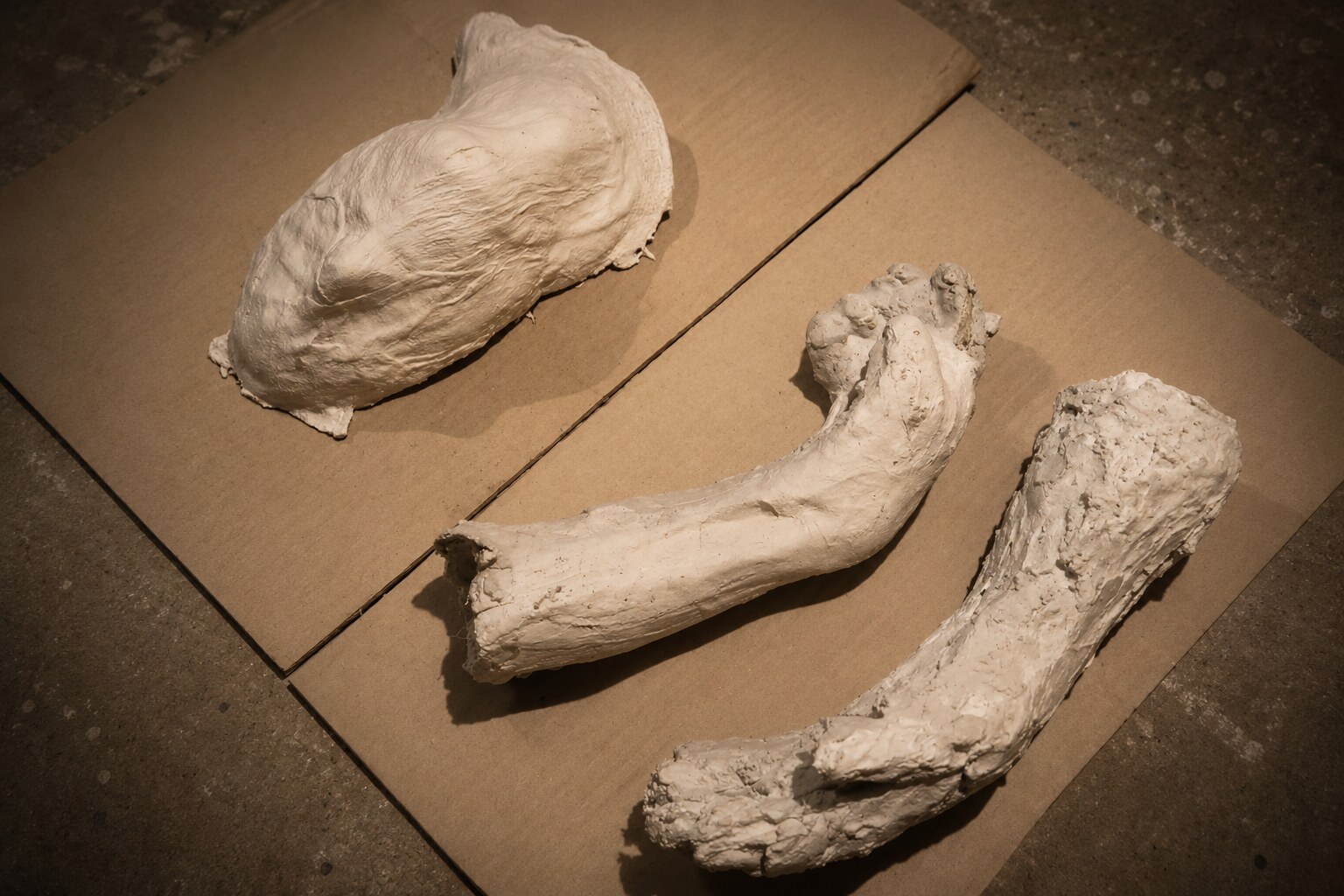
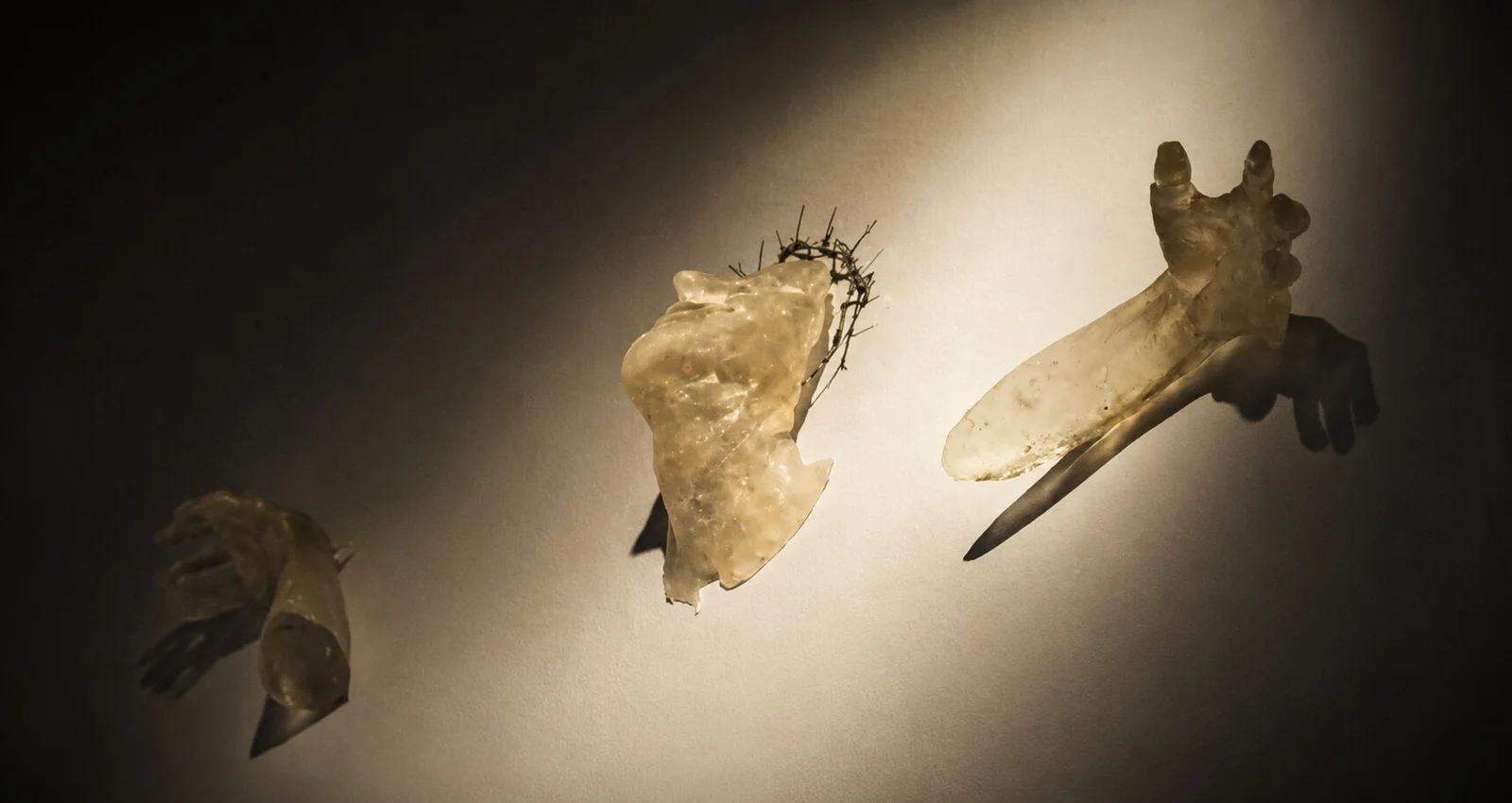
I have a piece from 2014 I return to often with this thought — before the current wave of artificial intelligence became common subject matter. A head of Christ with a crown of thorns made of wire, and two hands, cast in translucent resin, shown at the time at AnnArt Gallery, Bucharest, in the exhibition Metha-Lan. I wanted to say, even then, that art rounds itself out through testimony, the way faith requires confession as a completing act. Nothing about that piece can be verified from the outside — there is only my word, and the fact that I now claim, publicly, what I did then.
A note from the studio
What I left out of the original published version, but think worth adding here: my day-to-day practice functions as an ongoing laboratory for this same problem. The PREAPOCALIPTIC series didn't start from a concept anyone verified beforehand — it started from decisions made in front of the canvas, some reversible, some not, which I can recount today because I lived them, not because I documented them. Likewise the Seeds series — the 70-plus small-format works, conceived as a testing ground — exists for me as an archive of testimonies, not just outcomes. Each small piece is a decision I can explain after the fact, at the risk of getting the explanation wrong, exactly as described above.
Studio Sessions, the open sessions held at Doamnei 5, function, I think, as a practical form of the same idea: I'm not offering access to a finished object, but to the act underway, with me present, answering directly for the choices I make. It's the kind of testimony no provenance protocol can replace, because it doesn't document a process — it lives it together with whoever is watching.
Who answers for what they make
I started from logos — the unity of meaning, truth, and utterance Flaubert was after. I arrive, by another road, at a more modest stake, but a more useful one than ever: who answers for what they make.
What remains, then, is a single gesture: to take responsibility for what you claim. Only some traces are testimony, just as only some signatures remain kept promises. To answer for a work means, I think, something simple and verifiable: to be reachable, directly, about it — about the choices behind it — without hiding behind the process or the documentation. Perhaps that, in the end, is the only measure of a work's authority: whether there's still someone willing to answer for it, as for something lived.
A version of this essay first appeared, in Romanian, on LiterNet.ro, 06.08.2026.
Read Next
- What Trust in an AI Answer and the Authority of an Artwork Have in Common
- Bohemia Never Dies, It Just Self-Preserves
About the Artist
Adrian Dică is a Romanian painter. He exhibited at the Royal Academy of Arts Summer Exhibition, London (2024, work sold), won First Prize at the Chișinău International Painting Biennial (2021), and has works in the BRD Société Générale collection. More on the About page and his Wikidata profile.